Home / Finishing And Gear
Best Filament Dryer
A good filament dryer warms the whole spool, removes moist air and lets the filament feed smoothly. A falling humidity display alone does not prove it works.
Well-stored PLA in a dry room may not need a dryer. TPU, PETG, nylon, dissolvable support filament and spools that pop or bubble during printing are more likely to benefit.
Top pick
Accurate measured heat, strong moisture-removal test, four-spool capacity
Best for simple budget drying EIBOS Easdry · Best for one spool GratKit Firefly · Best for compatible Bambu systems Bambu Lab AMS HT

| Dryer | Category | Key Findings | Main Drawback | Closest Alternative |
|---|---|---|---|---|
1 |
Best overall and multi-spool | Accurate measured heat; test load lost moisture; holds four spools | Large, noisy, one shared chamber | SUNLU SP2 |
|
SUNLU FilaDryer S4 details
| ||||
2  |
Cheapest worth buying | Effective documented moisture-removal test for about $55 | Only 65°C and basic controls | GratKit Firefly |
|
EIBOS Easdry details
| ||||
3 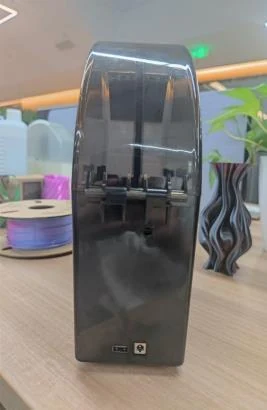 |
Best single-spool | Production model checked; drying and spool-weight tests showed moisture loss | App adds complexity without improving drying | EIBOS Easdry |
|
GratKit Firefly details
| ||||
4
No general winner
|
High-temperature materials | Available tests do not resolve safety and model-revision concerns | Requires a different tool or more waiting | Bambu AMS HT, for Bambu owners only |
|
No general winner details
| ||||
5  |
Bambu material system | Automated feed, 85°C setting, rotating mode, active vents | One spool; can’t dry while that spool prints | SUNLU S4 plus a separate AMS |
|
Bambu Lab AMS HT details
| ||||
5 dryers shown
No matches. Remove a filter to see more options.
Compare dryers side by side
Choose two dryers to compare their full details. Add a third if you need it.
Select two dryers to start comparing.

The SUNLU FilaDryer S4 is my top pick. Choose a smaller dryer if you use only one spool at a time. Check your filament’s drying temperature, because a 70 °C hobby dryer is not hot enough for every material.
Filament Dryers for Different Spools and Setups
Best Overall And Multi-Spool: SUNLU FilaDryer S4
The S4 holds four ordinary 1 kg spools, can feed up to four printers and reaches 70 °C.
In an independent probe test, settings from 50–70 °C stayed within 2 °C of the target. Another test used a sponge containing 2 mL of water; the S4 removed that amount within 30 minutes. This does not prove how quickly it dries the middle of a tightly wound spool, but it shows that it can remove moisture.
A separate test also found that PLA stopped stringing after five hours at 50 °C.
At roughly $117, it offers unusually good capacity per dollar. SUNLU specifies three layers of thermal protection and a one-year warranty.
Its central compromise is that all four spools share one heated chamber, so you can’t dry PLA and nylon at different settings together. It also drew about 295W and was the loudest of three models in an independent comparison. Don’t buy it for one occasional PLA spool, a cramped desk, or materials whose maker specifies more than 70°C.
The closest alternative is the SUNLU SP2. It holds two 1kg spools or one spool up to 3kg, separates its sealed box from the heating base, and also performed extremely well in an documented moisture-removal test.
It would be my compact all-round choice if the complete dryer kit were consistently in stock, but SUNLU’s confusing listings sometimes surface the storage box without the heater. Confirm the exact bundle before paying.
Cheapest Worth Buying: EIBOS Easdry
The Easdry costs about $55, and its simple temperature dial is more useful than a cheap touchscreen attached to weak hardware. The measurements I reviewed showed it removing 91.1% of the test water in an hour, with a 57°C maximum during that test.
EIBOS rates it for 40–65°C, one spool up to 220mm by 72mm, and 55W maximum power. That is enough for PLA, PETG, and many TPU drying recipes when the filament maker agrees.

Its limitations are plain: no timer, no precise digital temperature setting, and not enough verified heat for filaments calling for 80°C or more. EIBOS lists a one-year paid warranty, and return shipping terms are less friendly than those of bigger brands.
Don’t pick it for nylon or PC merely because those names appear on marketing material. The Firefly costs almost the same and gives you stronger controls, higher heat, and quieter measured operation.
Best Single-Spool Dryer: GratKit Firefly
The Firefly is a well-tested one-spool option. A retest of the production version found that it reached about 75 °C and removed the test’s full water dose in an hour.
Hoffman Engineering also weighed loaded spools before and after longer cycles. Two PLA spools lost 4 g and 8 g; two PETG spools lost 4 g and 6 g. Weight alone is not a precise moisture measurement, but those changes support the drying results.
It costs about $56, fits common 250g, 500g, and 1kg spools up to 72mm wide, and has feed-through ports, a continuous mode, dual temperature sensors, and tip-over shutoff. The measurements I reviewed showed only 34dB at 50cm, quieter than the S4.
Choose another dryer if you need two spools, unusually wide reels or separately controlled chambers. The 70 °C setting limit also falls short of some nylon and polycarbonate drying instructions. The Easdry is simpler and slightly cheaper. The Firefly adds better controls, safety features and stronger tests using actual spools.
High-Temperature Dryers: Why There Is No General Winner
This is where a responsible shortlist stops pretending. Prusa’s current guidance calls for 80°C for its ASA, 85°C for PC, 90°C for PA11-CF, and 95°C for PCCF. A 70°C box may improve a wet spool, but “better” isn’t proof that it completed the prescribed cycle.
The SUNLU E2 advertises 110°C and now has revised internal cooling, but an early test I reviewed found severe hot-air overshoot, while owners reported large chamber gradients. I found no independent retest that cleanly ties the revised retail hardware to uniform, safe drying.
PrintDry’s PRO4 has replaced the well-tested PRO3, but comparable PRO4 testing is still thin. The 85°C ELEGOO H1 HT is a preorder in the US until late October 2026. The new SUNLU S4 Pro has promising dual 85°C zones, yet it is too new for a mature performance record.

If your filament requires more heat than the dryer can reliably provide, use equipment that has been checked at the required temperature. A suitable dehydrator or drying oven is an option. Do not assume that a much longer cycle will make up for insufficient heat.
Best Bambu Material-System Option: Bambu Lab AMS HT
The AMS HT suits owners of compatible Bambu printers who want drying and automatic feeding for one spool. It reaches a stated 85 °C and supports 1.75 mm filament. Spools must be 197–202 mm in diameter and 50–68 mm wide.
Features include powered feeding, RFID profile selection for Bambu filament, spool rotation and active vents. It also has a flame-retardant housing, lid detection and an over-temperature cutoff.
The AMS HT is most useful as part of a Bambu setup. It is not the best dryer for every printer. In one test, a sensor above a PLA spool read about 49 °C while the display showed 58 °C.
Several owners also reported stuck exhaust valves. Bambu supplied warranty replacements, but closed vents can trap condensation. Check that both vents open and that nothing blocks them.
Most importantly, the AMS HT cannot dry a spool while that spool is feeding a print. Soft TPU and some abrasive filled materials must use its bypass rather than automatic retraction.
Don’t buy it without a supported Bambu printer, and don’t assume “HT” covers every engineering-filament recipe. For four-color work, an S4 used for batch drying plus an AMS for feeding is more flexible, though less automatic.
How To Tell Whether A Dryer Really Removes Moisture
Start with temperature where the filament sits, not the number beside the heater. Put an external probe near the top and center of a loaded spool, then compare it with the set point after the chamber stabilizes. A second probe near the bottom reveals gradients. Stable average heat matters, but so does avoiding a hot plate that can soften filament or warp a spool.
Next, look for circulating air and an escape route. Heat encourages absorbed water to migrate toward the filament’s surface. Airflow carries vapor away from that surface; a vent, periodic air exchange, or properly managed desiccant then keeps it from reaching equilibrium inside a closed box.
Tightly wound inner layers heat and exchange air more slowly, which is why drying a real spool takes hours even when a wet sponge dries quickly.

Don’t accept a falling relative-humidity display as proof. Relative humidity depends on temperature. Warm the same air without removing any water and its RH reading falls. A useful display can show trends—especially an early rise as a wet spool releases vapor—but it cannot measure the water remaining inside plastic.
Here is what each type of drying test can tell you:
- Check the heat near a loaded spool. An external probe shows whether the chamber reaches a steady temperature. It does not prove the filament has dried.
- Look for measured water loss. A known wet test load or a change in spool weight can show that moisture left the material. It does not show that every part of every spool dries equally.
- Compare prints before and after drying. Use the same model and settings. Better results show a practical benefit, but other causes of print defects still need checking.
- Treat the humidity display as a guide. It measures the chamber air, not the moisture inside the filament.
A useful drying test checks both the spool and the print. Weigh the spool, dry it for the material maker’s stated time and temperature, then let it cool in a sealed container before weighing it again. Print the same file with the same settings. Repeated readings that stop falling tell you more than touching the filament or judging one improved surface.
Is A Filament Dryer Worth Buying For Your Filament?
For nylon, PVA or BVOH support, TPU, and repeatedly exposed PETG, usually yes—especially in a humid room or during long prints. These materials can absorb enough water to cause popping at the nozzle, bubbles or pitting, excessive ooze, rough surfaces, and weaker bonds. A new sealed spool can also arrive damp.
For PLA, the answer is often no. If you open one spool, finish it quickly, and keep it sealed with refreshed desiccant between jobs, spend the money elsewhere.
PLA can absorb moisture over time, though, so drying is a sensible diagnostic when an old roll becomes brittle, pops, or strings despite known-good temperature and retraction settings.
Prusa suggests 45°C for six hours for its PLA; Polymaker commonly specifies 55°C for six hours for its own. Follow your exact filament and spool guidance, not a universal chart.
Treat symptoms as clues, not a verdict. Stringing can come from excess nozzle temperature, retraction, travel, or pressure settings. Weak layers can come from low extrusion temperature or under-extrusion. Compare an unchanged print before and after a documented drying cycle.
A dryer restores already wet material. A sealed box with dry desiccant slows reabsorption. Most humid-climate workflows need both functions, whether in one product or two containers.
Which Filament-Dryer Features Change The Choice?
Match the verified working temperature to the exact filament maker’s instructions. “Maximum 70°C” means little if an external probe sees 55°C around the spool. It also doesn’t override the spool’s heat limit: cardboard cores, adhesives, and plastic flanges may deform before the polymer does.

Capacity comes next. One spool is efficient for occasional work. Two or four are worthwhile for multicolor printing or several machines, but a shared chamber forces every reel onto one recipe. Independent zones matter only when you genuinely need different materials dried simultaneously.
Measure reel diameter, width, center-hole size, and weight; “1kg compatible” is not a dimension.
Moist air needs to escape or be captured. Prefer a deliberate vent and circulating fan over a nearly sealed heated box. A seal and desiccant become valuable after the cycle, when the goal changes from removal to storage. A removable dry box such as the SP2 concept handles that transition neatly.
For printing from the box, inspect roller freedom, outlet position, PTFE routing, and lid clearance. Excess bend or drag can cause under-extrusion or feeder errors. Filament doesn’t need to stay warm on its trip to the hot end; it needs to remain dry and move smoothly.
An inline system can condition only the strand being printed, but Drywise’s current €1,499 price pushes that solution toward professional production.
Finally, check timer length, power-loss behavior, noise, wattage, over-temperature cutoff, tip-over protection, certification, replacement parts, and warranty. A top-opening lid may also be frustrating under a shelf.
When Another Method Beats A Filament Dryer
A food dehydrator wins when it has verified, stable temperature control, active airflow, enough spool clearance, and a safe vented enclosure. It can offer more even heat or capacity for the money.
Its limitation is fit: many units run too cool, need tray changes, and offer no smooth print-through path. Don’t reuse an appliance for food after heating plastics in it.
A temperature-verified oven makes sense for an occasional high-temperature cycle that hobby dryers cannot reach. Household ovens often swing far beyond their dial setting and may not regulate safely at PLA temperatures; Prusa explicitly recommends an external thermometer. Confirm both the filament and spool can tolerate the measured heat.
A laboratory drying oven is the safer answer for valuable engineering materials, though its price is hard to justify at home.
A sealed dry box with fresh desiccant is better for storage and continuous feeding when the filament is already dry. It is quiet and cheap, but it usually cannot pull substantial moisture from a wet spool quickly.
An inline dryer beats batch equipment when production cannot pause and one costly, moisture-sensitive strand must stay conditioned for an entire print. Drywise has credible before-and-after nylon results, but its four-figure cost and consumables make it a professional tool, not a normal hobby purchase.
Filament-Dryer Questions Readers Still Ask
Is It Safe To Leave A Filament Dryer Running Overnight?
Only if the manufacturer permits the required duration and the unit has intact over-temperature protection. Put it on a stable, heat-resistant surface with vents clear, use the correct power supply, stay within spool and filament limits, and test a new unit while you’re awake first. Stop using it after error codes, unusual smells, fan failure, or visible deformation.
How Long Does Filament Take To Dry?
Usually several hours, not the time needed for the display to reach temperature. Material, diameter, winding density, initial moisture, airflow, load, and actual chamber heat all matter. Follow the filament maker’s recipe, start timing after useful temperature is reached, and extend only with evidence such as continued mass loss or improved controlled prints.
Can A Dryer Replace A Sealed Storage Box?
Not automatically. A vented dryer may exchange room air as soon as it switches off. Use a genuinely sealed chamber with maintained desiccant, or move the cooled spool directly into one. Conversely, storage alone is not a dependable recovery method for a wet spool.
Can A Food Dehydrator Dry Filament Safely?
Yes, if independent probes confirm it holds the needed temperature without hot spots, the spool fits away from the heater, and the materials are compatible with that heat. Treat it as dedicated workshop equipment, follow its safety instructions, and never assume its dial is accurate.


