E3D V6 hardened steel, 0.6 mm Review
More than the E3D brass equivalent; a lower-cost option than Nozzle X.
Our verdict
A useful upgrade for regular abrasive printing on a compatible V6 hotend when broad surfaces matter more than tiny details. The hardened steel resists wear and the 0.6 mm opening supports wider lines, but expect tuning rather than a guaranteed speed increase or lifespan.
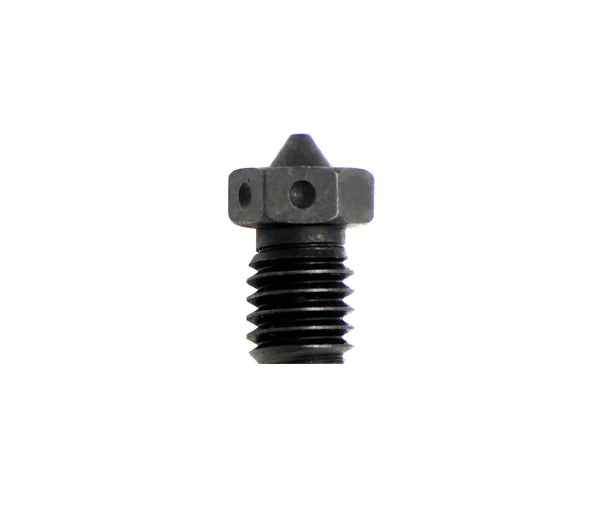
Best atRegular abrasive-filament printing of boxes, holders and other less intricate parts on a compatible hotend.
Less suited toUnfilled PLA or PETG printing where cheaper brass is sufficient, and parts with fine lettering or narrow features.
The Key Specs
| Exact size | 0.60 mm opening; 1.75 mm filamentSelect V6-NOZZLE-HS-175-600; filament diameter and opening size are different measurements. |
|---|---|
| Wear resistance | Hardened steelSuited to abrasive filled filaments; check the filament maker’s nozzle requirements. |
| Hotend fit | E3D V6 geometryM6 threads alone do not establish compatibility; this is not a replacement tip for a stock Bambu P1 hotend. |
| Print profile | 0.6 mm, standard flowWider lines can reduce passes, but hotend melting and cooling capacity still limit speed. |
| Heat transfer | Lower than brassAllow for temperature and flow tuning; some materials may need slower printing. |
| Temperature limits | Abrasive printing: no higher than 350°CObserve lower printer limits; E3D requires a plated-copper V6 block above 240°C with hardened steel. |
Which Nozzle Should You Buy?
- Hardened steel, 0.60 mm / 1.75 mm
- Choose the reviewed size for regular abrasive printing when it preserves the details you need.
- Brass, 0.6 mm
- Choose wider lines at lower cost if you mainly print unfilled PLA or PETG.
- 0.4 mm opening
- Keep the smaller opening for fine lettering and narrow features; choose an abrasion-resistant material only when your filament needs it.
Budget For Fitting And Upkeep. Allow for the specified installation tools and filament for calibration prints. MK4/S, MK3.9/S and original XL owners need a Nextruder V6 Nozzle Adapter. Hotter use above 240°C in an aluminium V6 block requires a plated-copper block upgrade. Cleaning filament and eventual condition-based nozzle replacement add upkeep costs.
More Fit And Ownership Details
| Dimensions | 12.5 mm overall length; M6×1 thread; 7 mm hexagon. |
|---|---|
| Size identification | Four dots identify the 0.60 mm opening. |
| Prusa fit | Original hotends on MK2 and MK3 families, MK3.5/S and MINI/+; MK4/S, MK3.9/S and original XL require the V6 adapter. |
| Installation | Final tightening must be done hot, using the procedure for the exact nozzle, heater block and printer. |
| Cleaning | E3D permits cleaning filament and warm or cold pulls for this hardened model; do not transfer this advice to Nozzle X. |
| Replacement | Check for blockage and incorrect settings before treating poor extrusion as wear; no dependable lifespan is established for this exact variant. |
The E3D V6 hardened steel 0.6 mm nozzle is worth considering if you regularly print abrasive filament and make parts that don’t depend on tiny details. Its two features solve different problems: hardened steel resists wear, while the larger opening lets you lay down wider lines.
I wouldn’t buy it just to make ordinary PLA prints faster. A brass 0.6 mm nozzle is cheaper and transfers heat more readily. With this hardened version, expect some tuning, check your heater block carefully, and don’t count on a particular speed increase or lifespan. Those results aren’t well established for this exact variant.
Check that this V6 nozzle fits your printer
Choose the genuine E3D hardened steel V6 version with a 0.60 mm opening for 1.75 mm filament. The listed manufacturer part number is V6-NOZZLE-HS-175-600. The two diameters mean different things: 1.75 mm describes the plastic entering the printer; 0.60 mm describes the hole it leaves through. E3D uses four identification dots for this opening size.
V6 describes the nozzle’s fit, not just its thread. E3D’s V6 drawing shows a 12.5 mm overall length, an M6×1 thread and a 7 mm hexagon for a spanner. An MK8 nozzle is a different format. Matching threads alone won’t establish that either nozzle will seal correctly or put the tip at the right height. Use the documentation for your actual hotend—the heated assembly that melts the filament.
Prusa documents V6 fit for the MK2 and MK3 families, MK3.5/S and MINI/+. That assumes the original hotend; an aftermarket conversion can change the answer. On an MK4/S, MK3.9/S or original XL, you need the Nextruder V6 Nozzle Adapter and the instructions for that model. The XL has separate single-tool and multi-tool procedures.
For a stock Bambu P1 printer, choose its model-specific hardened hotend instead. This screw-in V6 tip isn’t its replacement. Other Bambu models and modified hotends need their own compatibility check; “Bambu hardened steel” doesn’t identify a V6-compatible part.
What hardened steel changes for your filament
Abrasive filament contains particles that can wear away the nozzle as they pass through it. Carbon-fibre-filled plastics, metal-filled blends and some glow-in-the-dark filaments are reasons to consider hardened steel. Check the filament maker’s nozzle requirements: a decorative name or colour doesn’t tell you how abrasive a blend is.
Ordinary, unfilled PLA and PETG don’t give you the same reason to switch. Brass handles these materials well. Hardened steel transfers heat less readily, so the plastic may not melt enough at the speeds you used with brass. Prusa specifically warns that some materials, including ABS, may need slower printing.
Stainless steel isn’t an equivalent wear-resistant choice. E3D’s current V6 guidance labels stainless steel as non-abrasion-resistant. Older manufacturer experiments found it wore more slowly than brass, but it still suffered damage. Neither that finding nor its steel name makes it the right substitute for this hardened nozzle.
Coated alternatives need their own checks, too. DLC means diamond-like carbon; E3D identifies that coating with its original ObXidian range. Nozzle X uses a different WS2 coating. Nickel plating doesn’t identify the underlying metal, and a plated-copper nozzle isn’t a hardened-steel nozzle. Don’t assume these products share temperature limits or cleaning methods.

Check the temperature limits carefully. E3D’s product page gives a 500°C nozzle rating but prohibits abrasive printing above 350°C; its support table lists hardened steel at 350°C. Treat 350°C as the ceiling for abrasive printing, and stay below any lower limit your printer has. E3D also warns against hardened steel in an aluminium V6 block above 240°C and specifies a plated-copper block upgrade for hotter use. A nozzle can fit your printer and still be unsuitable for the filament you want to use.
What the 0.6 mm opening changes in your prints
The larger opening is useful for boxes, holders and other parts with broad surfaces. Wider lines can fill a wall with fewer passes. Taller layers can reduce the number of layers needed. Both can shorten a print, provided your printer can melt and cool the extra plastic quickly enough.
There’s a catch: a bigger hole doesn’t give the hotend unlimited melting capacity. Your slicer—the software that turns a model into printer instructions—may slow down wider or taller lines to stay within its flow limit. This nozzle remains a conventional V6 design, so don’t select a high-flow profile merely because the opening is larger.
Fine lettering, narrow grooves and thin decorative features are stronger reasons to keep a 0.4 mm nozzle. Check them in the sliced preview before buying. You can still use relatively thin layers with a 0.6 mm nozzle to improve curved and sloping surfaces, but that won’t recover every narrow feature seen from above. Wider supports can also be harder to remove.
Nor does 0.6 mm automatically mean stronger parts. Reported hook tests comparing 0.4 and 0.8 mm nozzles on a Prusa MK3S used PLA, no infill and a deliberately low flow limit of 3 mm³/s. Much of the strength advantage came from thicker walls. Those tests don’t measure this hardened 0.6 mm nozzle. The useful lesson is to compare actual wall thickness, not just the number of wall lines.
Cooling still matters. Adding more hot plastic can increase the risk of warping with susceptible materials. Don’t assume the fastest profile will also give you the cleanest overhangs or the most accurate part.
How well this E3D nozzle prints and wears
The evidence supports choosing hardened steel for abrasion resistance more firmly than it supports promises about this nozzle’s finish, maximum speed or service life.
A published microscope inspection found good machining on an E3D hardened V6 nozzle. However, its opening size wasn’t identified, and the inspection wasn’t a timed printing or wear comparison. That’s a narrow positive sign about the inspected sample, not proof that every E3D nozzle will produce better-looking parts.
E3D’s own earlier wear investigation showed a hardened nozzle retaining its shape after abrasive printing, alongside badly worn brass examples. That supports the material’s purpose, but it doesn’t establish how many spools this exact 0.6 mm version will last in your printer. Different fillers and printing conditions prevent a dependable replacement schedule.
There also isn’t enough evidence tied to this exact version to identify a recurring defect or quote a meaningful complaint rate. Problems reported for unspecified hardened nozzles, Nozzle X or a complete V6 hotend shouldn’t automatically count against this product. Having to adjust settings for its slower heat transfer doesn’t, by itself, mean the nozzle is faulty.
Replace it according to condition. If previously consistent prints deteriorate, first check for a blockage and confirm that you’re using the right settings. Poor extrusion alone doesn’t prove wear. A visibly enlarged or uneven opening, or a damaged, shortened tip, gives you a firmer reason to replace it.

Cleaning may restore a blocked nozzle, but it can’t rebuild worn metal. E3D permits cleaning filament and warm or cold pulls for this hardened model; these methods remove trapped plastic from inside. Follow the relevant cleaning procedure, and don’t carry that advice over to Nozzle X, which has different coating restrictions.
Setting up the hardened 0.6 mm nozzle
Allow time for installation and a few small calibration prints. Start with the complete nozzle-change guide for your printer and the instructions for your nozzle and heater block. Unload the filament, support the heater block with the specified tool, and protect its heater and temperature-sensor wires while working.
The seal is inside the block, where the nozzle meets the heatbreak—the tube carrying filament into the heated section—or the Nextruder adapter. Tightening the nozzle’s hexagon flush against the block doesn’t create that seal. The specified gap beneath the block is intentional, and V6 nozzles require final tightening while hot.

The tightening temperature and force depend on the assembly. E3D’s general hardened-V6 guide specifies 20°C above printing temperature and 2 Nm of torque, the force used to turn the nozzle. Its V6 hotend guide separately specifies 300°C tightening for hardened steel with an upgraded plated-copper block. Prusa’s XL and MK4S adapter guides specify 250°C and 1.5 Nm. If the instructions conflict with your nozzle, block or printer limits, get manufacturer guidance before heating it.
In the slicer, select your printer’s 0.6 mm standard-flow profile, then match the nozzle-diameter setting on the printer where available. If you’re making a profile manually, adjust extrusion width—the width of each printed line—as well as nozzle diameter. Changing only the diameter field doesn’t necessarily make the lines wider.
Layer height is separate. Prusa’s general upper guideline is 70–80% of nozzle diameter, or roughly 0.42–0.48 mm here. That’s an upper limit, not a recommended starting point. Use a supported profile with thinner layers while you tune.
Prusa suggests about 5°C more heat for hardened steel; other published guidance suggests around 10°C. These are starting suggestions, not a universal correction to add automatically. Test temperature within the filament and printer limits, then check flow at your intended speed. If the filament-feed mechanism clicks or lines become thin at higher speeds, slow down and investigate before increasing temperature again.
Finally, repeat the first-layer calibration required by your printer. On a multi-tool XL, complete the prescribed tool-offset calibration so the printer knows where each nozzle sits.
Is this E3D nozzle worth buying for your prints?
I’d choose this nozzle for regular abrasive printing on a compatible machine when 0.6 mm preserves the details you need. Its value is avoiding the rapid brass wear that abrasive fillers can cause, with a larger opening suited to less intricate work. It costs more than E3D’s brass equivalent, while E3D positions it below Nozzle X in price.
If you mainly print unfilled PLA or PETG and want wider lines, choose brass in 0.6 mm. If small lettering or fine features matter more, keep 0.4 mm and choose an abrasion-resistant material only when your filament requires it.
For a Nextruder printer, weigh the adapter and installation work against a compatible abrasion-resistant Prusa Nozzle. And if your abrasive filament needs temperatures above 240°C in an aluminium V6 block, account for E3D’s block-upgrade requirement before buying. This nozzle is useful when both its material and its size solve a problem you already have.


