GratKit Firefly Review
Refurbished listings cost less than new; check condition and regional availability.
Our verdict
A compact single-spool dryer worth considering for PLA or PETG when phone control is useful. Check spool fit, hardware revision and seller support first; older drying reports do not establish how every V2 unit performs.
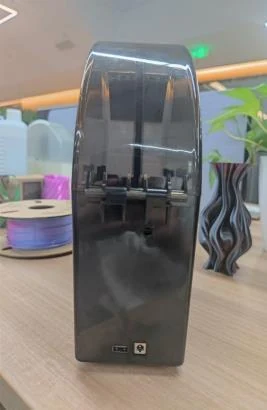
Best atOne compatible spool of PLA or PETG, especially when remote adjustments save trips to the dryer.
Less suited toSeveral spools at once, frequent color changes, wide reels or grades requiring drying above 70°C.
The Key Specs
| Drying settings | 40–70°C; eight presets and two custom modesMatch the filament maker’s drying instructions and the reel’s heat limit; presets do not establish when a spool is dry. |
|---|---|
| Spool fit | One spool; advertised width up to 72mmA refurbished V2 owner reported a 70mm limit. Confirm wide reels, outside diameter and center-hole fit before buying. |
| Controls | Touch controls plus Tuya Smart / Smart LifeOrdinary drying works without a phone; the apps add remote adjustment. |
| Printing while drying | Two filament feed holesRemoving a loaded spool requires unloading filament from the printer first. |
| Footprint | 254 × 261 × 102mmLeave extra room to open the lid and route filament without a sharp bend. |
Which Firefly Should You Buy?
- New, with US power plug
- The straightforward US purchase choice. Ask the seller to identify the hardware revision and service arrangements.
- Refurbished V1 or V2
- A lower-cost option when offered, but confirm condition, revision and return terms; refurbished reports do not describe every new unit.
Budget Beyond the Dryer. Allow for electricity during drying cycles. A different spool center hole may require a printed holder in PETG or a more heat-resistant material. Check potential repair and return-shipping costs with the seller.
More Drying And Ownership Details
| Temperature limits | GratKit bases its 70°C claim on a 25°C room; cooler surroundings can limit the temperature reached. |
|---|---|
| Humidity display | Measures air inside the enclosure, not moisture remaining in the filament. |
| Timer | 00:00 means continuous heating until you stop it. |
| Spool holder | Load the roll on the hanging center holder; printable replacements include 58mm and 75mm center-hole designs. |
| Power adapter | Published specification: 100–240V AC input, 24V 2A DC output. Confirm the supplied US adapter. |
| Service checks | GratKit documents early display-cable damage and heating-start reboot issues. Confirm revision and support before ordering. |
The GratKit Firefly makes sense if you want a compact, single-spool filament dryer that you can adjust from your phone. Reported PLA and PETG drying results are encouraging, and its custom settings are useful. I’d consider it for that combination, provided your spools fit and your seller can identify the hardware and explain the warranty.
I’d be more cautious if you mainly print nylon, swap spools often or want a dryer with a well-established reliability record. Older Firefly tests don’t automatically describe a Firefly V2.0 listing, and documented support issues deserve attention alongside the convenient controls.
Which Firefly version are you buying?
The name alone doesn’t settle this. GratKit still lists the Firefly on its US-facing storefront, but its public specifications don’t provide a clear guide matching V2 labels to particular hardware changes.
There are three different kinds of evidence to keep apart. An early test unit struggled to reach its selected temperature. A later, manufacturer-supplied replacement performed better in a retest. Separately, a 2025 owner report explicitly identifies a refurbished Firefly V2. Those reports describe different units, and the refurbished unit doesn’t establish what you’ll receive when buying new.
GratKit also documented an updated display cable in January 2024. That confirms a change, but it doesn’t establish that every listing marked V2 contains a particular cable, heater or adapter.
Before ordering, get confirmation of the version, whether it’s new or refurbished, and the supplied US power adapter. The published specification is 100–240V AC input with 24V, 2A DC output. A photo of the unit and adapter labels is more useful than a seller simply repeating “upgraded.” If the revision remains unclear, treat older performance reports as a guide rather than a promise.
How well does the Firefly dry filament?
The Firefly has demonstrated useful drying, but the evidence doesn’t establish a universal drying time or guaranteed improvement in your prints. Moisture can contribute to fine strings between printed parts and poor surfaces. Those symptoms alone don’t tell you how wet a spool is.
In one reported test using the built-in profiles, a Two Trees white PLA spool lost 4g over 12 hours. Creality Hyper PLA lost 8g over almost 24 hours. Overture black PETG lost 4g over 24 hours, while white PETG lost 6g over 12 hours. The PETG observations had start and end weights, without detailed hourly logs.
Those results are consistent with moisture leaving the loaded spools. They don’t isolate water in the filament from moisture in the spool itself, establish complete drying or show a controlled before-and-after improvement in printing. They also weren’t identified as V2 tests. Plan around your filament maker’s instructions, not the expectation that every roll will finish in one short cycle.
The tested PLA preset was only 40°C for four hours. That’s a starting setting, not proof that four hours is enough. The Firefly offers eight material presets, two saved custom modes and a selectable 40–70°C range. Use a custom mode when your filament’s recommended temperature and time differ from the preset. Check the reel’s heat limit too; the filament and the spool holding it aren’t necessarily made from the same plastic.
Temperature reports need context. GratKit bases its 70°C claim on a 25°C room and says cooler surroundings can prevent the dryer reaching that temperature. The replacement-unit retest reported a peak around 75°C after 20 minutes; its comparison data lists 74°C at 24°C ambient temperature and 40% relative humidity. So 74°C has a reported measurement behind it, but it isn’t the advertised setting limit or proof of even heating throughout a full spool.

The Firefly also reached the reported 100% endpoint in a one-hour experiment drying 2ml of water from a sponge. That measures evaporation from a sponge, not removal of all moisture from filament. The endpoint was capped at 100% in the published table when additional starting moisture pushed measurements higher.
A fan moves heated air around the spool, and the enclosure allows moisture to escape. Its humidity reading describes the air inside, not water remaining within the plastic. A low reading cannot certify that your filament is ready.
For nylon or polycarbonate, check the exact grade. Some engineering filaments require drying above 70°C; the Firefly can’t provide those specified conditions. A material name in its preset menu doesn’t override the filament manufacturer’s instructions.
Will your spools fit and feed smoothly?
Measure your spool before buying. GratKit advertises support for 250g, 500g and 1kg rolls up to 72mm wide, but the refurbished V2 owner reported a practical limit of 70mm. That difference remains unresolved. If your rolls measure 71–72mm, get fit confirmation for the actual unit and a usable return option.
Width is only part of the fit. You also need the outside diameter and the size of the center hole. GratKit doesn’t clearly state the largest outside diameter or full range of center-hole sizes it accepts. A “1kg” label describes the amount of filament, not the reel’s shape.
The manual tells you to load the roll on the hanging center holder. Although there are bearing rollers underneath, don’t assume they’re an equivalent substitute for that loading instruction. GratKit acknowledges that the supplied holder won’t fit every center hole and offers printable replacements, including designs for 58mm and 75mm holes. It specifies PETG or a more heat-resistant material for these parts.
The body measures 254 × 261 × 102mm, roughly 10 × 10.3 × 4 inches. Allow additional room to open the lid and route filament to your printer without a sharp bend.
You can print through either of two feed holes while drying. The catch is spool removal: you’ll need to unload the filament from your printer and withdraw it through the hole before lifting out the roll. That’s manageable when one spool stays loaded for a long print, but inconvenient if you change colors frequently. Check that your loaded spool turns freely and that the filament feeds without rubbing before starting a job.
Does the Firefly app make drying easier?
It can, especially if the dryer sits away from your desk. You can change settings on the dryer itself, so a phone isn’t required for ordinary drying. The touch controls let you select profiles and adjust temperature and time. Be aware that setting the timer to 00:00 means continuous heating, not an immediate stop.
For phone control, GratKit documents Tuya Smart and Smart Life. Pairing involves pressing the power button during the startup logo, then adding the device in the app with the requested wireless permissions. Wi-Fi enables control over the internet; the documented Bluetooth option is for nearby use.
Reported app functions include selecting presets, changing temperature and duration, and viewing temperature and humidity. One hands-on account described a delay of a few seconds between a command and the dryer’s response. That’s unlikely to matter when extending a drying cycle, but don’t expect instant feedback.

Tuya remains available for iPhone and Android, although the app has changed since those early reports. Don’t assume an old demonstration exactly matches today’s screens. A refurbished V2 owner achieved partial local Home Assistant control through a custom integration; that doesn’t promise straightforward Home Assistant, HomeKit or voice-assistant compatibility for your unit.
As for fan noise, a reported Firefly measurement was 34dB with the meter 50cm away. That suggests modest noise in that test, but doesn’t establish how every V2 fan will sound beside you in a quiet room.
What do Firefly fault reports actually establish?
They establish specific problems worth checking with your seller, not a dependable failure rate.
GratKit’s support guide acknowledges an early display cable that could get pinched by the lid. Its January 2024 update says the revised cable reduces that risk. The guide also attributes rebooting when heating starts to the power supply entering protection and directs owners to support for an updated supply. These are documented support issues, rather than conclusions drawn from anonymous ratings.
A separate refurbished V2 report recorded roughly 80W at a smart wall plug during initial heating, against a published 48W rating. Wall input and adapter output are different measurements, and the report lacks calibration details and raw data sufficient to establish an electrical fault. It doesn’t justify fitting a different adapter yourself.
The melted-filament discussion also has an original owner report. In January 2026, that owner said ABS was damaged after running at the default 65°C setting. A follow-up described a warped heater plate and questioned the heater’s protection arrangement. The owner also reported returning the unit through Amazon. These remain owner observations; neither the actual incident temperature nor the exact production revision is independently established. Comments blaming high settings or poor quality control don’t resolve the cause.
GratKit advertises upper and lower temperature sensors and heater shutoff if the dryer tilts beyond 45 degrees. Those features don’t prove that every overheating scenario is covered. Equally, the incident and positive drying reports can’t establish which dryer is most reliable.
The published manual states a one-year warranty covering listed electrical parts and the case, with exclusions including misuse and wear. Confirm how that applies to your seller and condition, who handles a defective unit and who pays return shipping. GratKit lists spare parts, but listings alone don’t guarantee prompt repair. If your unit behaves abnormally, follow the manual’s instruction to turn off power and contact support.

Is the Firefly worth it for your setup?
I’d shortlist the Firefly for one compatible spool of PLA or PETG when phone control would save you repeated trips to the dryer. I’d look elsewhere for several spools at once, wide reels or filament whose drying instructions require more than 70°C. If the seller can’t clarify the hardware and service arrangements, I’d choose another option.
The closest useful comparison is the original, single-spool Creality Space Pi. It offers a 45–70°C range, local controls and timed drying. The Space Pi Plus holds two spools, and the X4 is another model again; don’t mix their specifications into this comparison.
Both the single-spool Space Pi and Firefly reached the one-hour endpoint in the reported sponge test, under different room conditions. That doesn’t establish a winner for your filament. Compare actual spool fit, loading, controls and the seller’s return terms. The Firefly’s app is a reason to choose it if you’ll use it, but it doesn’t establish better drying or justify any extra cost by itself.
Older PrintDry Pro3 and eSUN eBOX reviews need care too: PrintDry now sells a PRO4, while eBOX, eBOX Lite and eBOX Pro are distinct products. An older model’s results shouldn’t decide a newer purchase. For the Firefly, the strongest case remains compact, adjustable drying with convenient phone control—and a seller who can answer the practical questions before you buy.


