MatterHackers PRO ABS Review
Premium ABS · costs more than MH Build ABS
Our verdict
I’d try one spool if you already print ABS successfully and want MatterHackers’ stated diameter and color control for repeated parts. I wouldn’t pay the premium expecting stronger parts or fewer failures: those advantages over cheaper ABS are not established.

Best atRepeated functional ABS parts where consistent filament diameter and color matter.
Less suited toLearning ABS, occasional budget projects, or trying to solve warping with a more expensive spool.
The Key Specs
| Diameter control | Advertised ±0.02mm toleranceControls filament thickness; it does not guarantee printed-part accuracy. |
|---|---|
| Printer setup | Enclosure and hot bedSteady warmth helps limit lifting and layer splitting; ventilation is still needed. |
| Nozzle / bed | Listing: 230–240°C / 80–110°CThe listing gives 240–260°C for high-speed printers. Follow your spool guidance and printer limits; older documentation differs. |
| Build surface | PEI or glass with suitable adhesiveFollow the plate instructions and check the first layer before a long print. |
| Part fit | ABS shrinks as it coolsPrint a small sample with the important holes or joints and check the cooled dimensions. |
Which Spool Should You Buy?
- 1kg spool
- I’d start here to check fit, finish and feeding before buying in bulk. Choose the diameter your printer uses: 1.75mm or 2.85mm.
- Selected 5lb / 10lb spools
- For established repeat jobs. Check the chosen color and diameter, plus holder clearance and free rotation; built-in feeders may not accommodate them.
- Color choice
- For matching housings or repeated parts, choose the color you need and evaluate its consistency before committing to a larger supply.
Budget Beyond The Spool. Allow for suitable bed adhesive, dry storage, an enclosure and ventilation if your setup lacks them, plus filament used for trial parts. HIPS supports add support filament, limonene, a solvent-compatible container, protective equipment and waste handling.
More Handling And Compatibility Details
| Reviewed grade | Regular PRO Series ABS; separate from MH Build ABS and the specialized ESD-safe version. |
|---|---|
| Storage | Keep dry and away from sunlight. Ask for PRO ABS and spool-specific guidance if drying is needed. |
| Cooling | General ABS guidance starts with the part-cooling fan off; small features and bridges may need cooling. |
| Dissolvable supports | MatterHackers demonstrated PRO ABS with HIPS. This needs compatible same-layer material switching and adds a solvent-removal workflow. |
| Temperature guidance | An older technical sheet lists 220–240°C nozzle and 100–130°C bed. Resolve conflicts with MatterHackers; do not exceed printer limits. |
I’d consider MatterHackers PRO Series ABS if you already have an enclosed printer and need functional parts made from ABS. Its clearest selling point is the manufacturer’s promise of closely controlled filament diameter and color. That can matter when you’re making the same part repeatedly.
I wouldn’t pay more just to get stronger parts or fewer failed prints, though. The available evidence doesn’t establish those advantages over cheaper ABS. You’ll still need a hot bed, a suitable printing surface and ventilation that controls emissions. If you’re learning ABS, ordinary ABS is the more sensible starting purchase; if your printer is open, consider PETG first.
What The PRO Label Gets You
This is MatterHackers’ regular PRO Series ABS, separate from MH Build ABS and the specialized ESD-safe version. ABS is the plastic type; PRO identifies the product line. ABS is useful for functional parts because of its toughness and heat resistance, but the PRO label doesn’t change the basic demands of printing it.
The US catalog lists 1.75mm and 2.85mm filament, with 1kg spools and selected larger 5lb and 10lb options. Match the diameter to your printer. A larger spool also needs a holder that can accommodate it and let it turn freely; don’t assume it fits a built-in feeder.
MatterHackers advertises a ±0.02mm diameter tolerance and says it uses laser measurements, recorded production data and color checks. Those are useful manufacturing commitments. Consistent filament thickness helps the printer feed the intended amount of plastic instead of depositing too much or too little.
That tolerance describes the filament on the spool. It doesn’t promise that a printed hole or bracket will be accurate to ±0.02mm. ABS shrinks as it cools, and your printer settings still affect the result. You’re buying a stated level of control over the raw material, without a matching guarantee for finished-part dimensions.
What Your Printer Needs For PRO ABS
The current 1kg product listing recommends a nozzle temperature of 230–240°C, or 240–260°C for high-speed printers, and a bed at 80–110°C. Check your printer’s permitted operating temperatures before buying.
The documentation isn’t fully consistent. An older PRO ABS technical sheet gives 220–240°C for the nozzle and 100–130°C for the bed. That isn’t a reason to push your bed to 130°C. Follow instructions supplied with your spool and the printer’s limits; if they conflict with the listing, ask MatterHackers which guidance applies.
Plan on an enclosure, especially for broad, flat parts or tall prints. A warm, steady environment helps prevent uneven cooling from pulling corners off the bed or splitting layers apart. A premium spool won’t compensate for a cold draft.
PEI, a common print-bed coating, or glass with a suitable adhesive can work for ABS. Follow your particular plate’s instructions: an adhesive may also protect the surface by helping the cooled print release. The first layer needs to stick evenly across the part, so check bed leveling and the nozzle’s starting height before attempting a long print.
For general ABS setup, MatterHackers suggests starting with the part-cooling fan off so the plastic cools slowly, reducing the risk of lifting and splitting. Small features and sections printed across gaps may need some cooling to hold their shape. Treat this as a starting point, not a tested set of PRO ABS settings for every printer. There’s no universal printing speed, either.
Keep the spool dry and away from sunlight between jobs. Don’t borrow a drying temperature from another material; get advice for PRO ABS and its spool if drying is needed.

You also need a way to remove printing fumes and particles. An enclosure with exhaust ventilation to the outdoors can help, alongside suitable room ventilation. A closed box alone doesn’t establish safe indoor use, and smell can’t tell you whether exposure is controlled.
HEPA filtration captures particles; gases require appropriate gas or vapor filtration. If you can’t arrange suitable controls, skip ABS for now.
How PRO ABS Holds Up In Printed Parts
The useful question is whether the finished part stays flat, fits and survives its intended job. Tight filament tolerances alone can’t answer that.
Older university testing, published by MatterHackers in 2019, illustrates the setup problem. Black PRO Series ABS was printed as loop-shaped samples laid flat for pulling tests on unenclosed Prusa i3 MK2 printers. The baseline used 0.3mm layers, a 50% infill setting for the plastic structure inside each sample, and 30mm/s printing, with filament kept in dry storage.
Most ABS batches suffered warping, and the researchers stopped short of expanded testing because printing was troublesome. They called for testing in a warmer environment.
That result is a reason to take the enclosure seriously. It doesn’t establish how current PRO ABS compares with ordinary ABS on a properly enclosed printer. Nor does it establish a recurring defect in today’s spools.
MatterHackers’ technical sheet lists 5,800 psi tensile strength at break and 6,520 psi yield strength, citing the ASTM D638 pulling-test standard. These describe different points in a pulling test: breaking versus beginning to deform permanently.
The product’s headline 6,520 psi figure shouldn’t be read as the breaking strength of your printed bracket. The sheet doesn’t give the printing conditions or how the test samples were positioned during printing, so you can’t apply those numbers directly to your part.
Heat claims need similar care. MatterHackers advertises resistance up to 85°C, but that isn’t a safe continuous operating temperature for every shape and load. Even a heat-deflection result measures bending under particular test conditions; it doesn’t establish how long a loaded part will last in heat. Don’t choose PRO ABS for a safety-critical or high-heat job on that number alone.
For parts that must fit together, print a small sample containing the important holes or joints and check it after cooling. Uniform filament can’t eliminate shrinkage. Avoid applying a blanket size correction before checking what your printer produces.
Surface appearance and layer bonding also need separate checks. A neat outer wall doesn’t prove the layers are firmly joined, and an attractive example doesn’t establish consistent finish across spools. There’s no solid comparative basis here for promising smoother walls, less warping or stronger layer bonds than cheaper ABS.
Supports And Finishing For PRO ABS Parts
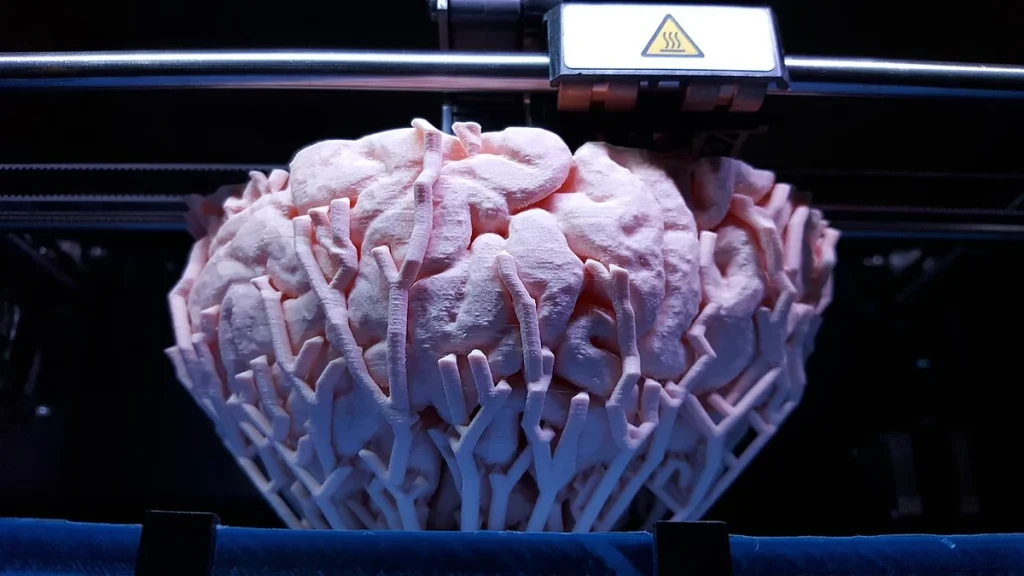
PRO ABS can be printed with a second plastic to support areas that would otherwise hang in midair. MatterHackers demonstrated a ten-hour Bulbasaur planter using teal PRO ABS and natural HIPS, a support plastic that dissolves in the solvent limonene. The company reported clean surfaces where the supports touched the model.
That example shows a possible workflow for awkward shapes. It doesn’t establish repeatable support quality or prove the planter will withstand outdoor weather.
You’ll need a printer that can switch between ABS and HIPS within the same layer, with compatible temperatures and a feeding system that supports both filaments. Check the exact HIPS product and your printer’s support settings before committing. Dissolving supports also adds a solvent-compatible container, waiting time and waste handling.
Limonene is flammable and can irritate skin and eyes. Use ventilation, suitable gloves and eye protection, keep it away from ignition sources, and follow its safety sheet and disposal requirements.
For a simple part with supports you can easily reach and remove, that extra work may buy you very little. Sanding is another ABS finishing option, but allow for the material you’ll remove where dimensions matter.
When Paying More For PRO ABS Makes Sense
I’d consider one spool of PRO ABS if you already print ABS successfully and want to evaluate its stated diameter and color control for repeated parts. A run of matching housings, for example, gives you a practical reason to care about consistent color. Buy the larger spools after you know the material and feeding arrangement work for you.
The closest cheaper alternative is MatterHackers MH Build ABS. Its stated diameter tolerance is ±0.03mm, compared with PRO’s advertised ±0.02mm. PRO promises tighter control of filament thickness, but that doesn’t tell you whether you’ll notice a difference in your prints. Color and diameter availability vary, so check the option you actually need.
If your ordinary ABS already gives you parts that fit and hold up, there’s no demonstrated performance gain here that makes switching necessary.
If you try PRO, compare the same useful part for fit, lifting, finish and failures under comparable conditions. Include wasted filament and your time before deciding whether it costs less per successful part. The PRO label can’t establish that saving in advance.
For an open printer and everyday functional parts, PETG is generally easier to print with less warping, provided it meets your part’s temperature needs. For prolonged sun exposure, ASA is the more appropriate material to investigate because it resists UV better than ABS; it still needs suitable printing conditions and ventilation.
If you’re hoping the more expensive spool will solve lifting corners, weak layers or an unsuitable workspace, address those problems before buying PRO ABS.


