SCIGRIP 16 Review
The smaller 1.5 oz tube costs less upfront than the 5 oz tube.
Our verdict
SCIGRIP 16 suits professional acrylic assemblies where coating the surfaces before joining is practical. Its thicker body does not guarantee a tidy seam or compensate for poor fit. Pass for casual home repairs and unverified PLA applications, and distinguish it from the reformulated US Weld-On 16.
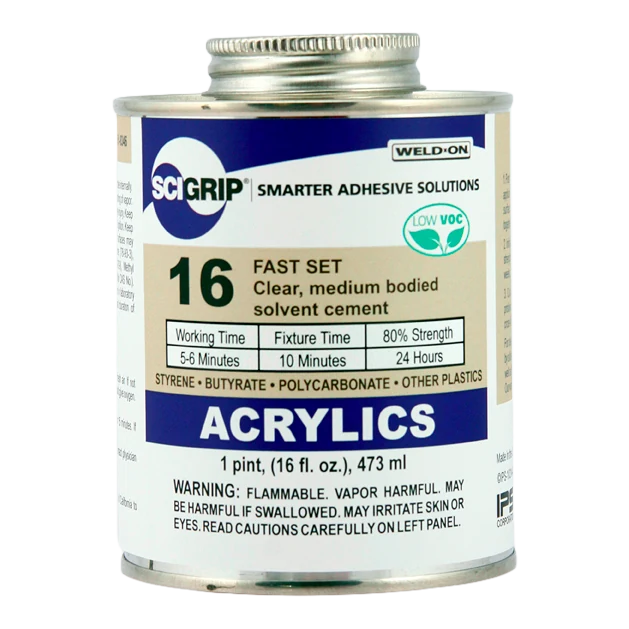
Best atProfessional acrylic fabrication with well-fitting parts and a rehearsed application method.
Less suited toCasual home repairs, unverified PLA bonding and aquarium repairs without project-specific approval.
The Key Specs
| Intended users | Industrial and professional onlyThis is not a consumer repair adhesive. |
|---|---|
| Formulation | SCIGRIP 16 contains methylene chloride (DCM)The current US Weld-On 16 DCM & TCE Free is a different formula; older results do not verify its performance. |
| Primary material | Acrylic; PLA is not explicitly listedDo not assume compatibility with every 3D-printing plastic. |
| Consistency | Clear, medium-bodied cementCoat surfaces before assembly; clear cement can still leave visible deposits. |
| Assembly timing | 5–6 minutes working; 10 minutes fixture at 73°FHave supports ready; initial holding time is not full-load readiness. |
| Joint fit | Clean parts that meet without forcingNo published maximum gap supports using it to rebuild missing material. |
Which Formulation And Pack Should You Buy?
- SCIGRIP 16: 1.5 oz or 5 oz tube
- Professional users in supported markets who need a tube; choose a quantity suited to the work and practise dispensing on scrap.
- SCIGRIP 16: pint or gallon can
- Professional workshops with repeated fabrication work and a suitable brush, polyethylene squeeze bottle or dispensing gun.
- US purchasing: Weld-On 16 DCM & TCE Free
- Professional US buyers should check this replacement by its full name and matching technical and safety sheets; it is not the reviewed formula.
Budget For Application And Handling. Allow for matching scrap, supports or clamps, and a suitable applicator. Workplace ventilation, chemical-resistant gloves and eye protection must follow the matching safety sheet and workplace assessment.
More Compatibility And Storage Details
| Other listed plastics | Rigid PVC, ABS, styrene, butyrate and polycarbonate. |
|---|---|
| Regional scope | SCIGRIP lists 16 for Europe and Asia only. |
| Storage | Keep tightly closed, out of direct sunlight and below 80°F; solvent loss thickens the cement and reduces effectiveness. |
| Strength development | Strength increases after the initial set; published acrylic results are not a load rating for your assembly. |
| Water exposure | Water- and weather-resistance claims do not establish continuous immersion or aquarium suitability. |
SCIGRIP 16 makes sense for professional acrylic work when you want a thicker cement that you can apply before bringing the parts together. Its main drawback is getting a neat seam: a squeeze tube doesn’t automatically give you precise control, and clear cement can leave visible deposits.
For a US home repair, I wouldn’t buy it. SCIGRIP labels 16 for industrial and professional use only, and the current US Weld-On 16 has a different formula with the same user restriction. Before judging its strength or choosing a tube, make sure you know which product you’re considering.
Which SCIGRIP 16 product are you buying?
SCIGRIP 16 is an acrylic cement, with additional listed uses on rigid PVC, ABS, styrene, butyrate and polycarbonate. That doesn’t make it a glue for every plastic. In particular, the manufacturer’s list doesn’t explicitly include PLA, the plastic commonly used in home 3D printing.
The naming needs care. Older discussions often use SCIGRIP 16 and Weld-On 16 interchangeably. Today, SCIGRIP’s product page says its 16 is available only in Europe and Asia. Its linked technical sheet identifies methylene chloride, also called DCM, among the ingredients.
Meanwhile, Weld-On announced replacement formulas in 2025. The current US version is Weld-On 16 DCM & TCE Free, identified by a green logo. It omits methylene chloride and trichloroethylene. Don’t transfer an old SCIGRIP result to this version just because both tubes say 16.
The distinction also affects who can buy and use it. EPA rules prohibit manufacturing, processing and distribution of methylene chloride for consumer uses. Certain industrial and commercial solvent-welding uses can continue under a Workplace Chemical Protection Program, which requires exposure controls and monitoring.
Removing DCM doesn’t turn the replacement into household glue: its technical sheet still specifies professional and industrial users. For professional US purchasing, ask your plastics distributor for the full product name and matching technical and safety data sheets. A listing that says only “Weld-On/SCIGRIP 16” isn’t enough to identify the formula, and it doesn’t establish stock at a nearby store.
Applying SCIGRIP 16 without spoiling the joint
If you’re using SCIGRIP 16 in an appropriate professional setting, fit the pieces together before opening the cement. They should be clean and meet without being forced into position. Have the supports or clamps ready so you can assemble the joint promptly.
The manufacturer permits application to one or both surfaces using a brush, polyethylene squeeze bottle or dispensing gun. When coating only one surface, bring the pieces gently together for several seconds to soften the uncoated side. Then press them firmly together while they’re still wet and hold or clamp until the initial set.
The tube is where convenience can become frustration. One owner reported over-dispensing, strings and tips blocking between applications. A separate owner, assembling laser-cut acrylic boxes, brushed 16 from a puddle onto the tabs. The puddle developed a skin, leaving strings and uneven deposits. These accounts describe particular jobs; they don’t establish how often problems occur.
A dated April 2023 owner report also cautioned that dispensing straight from the tube made a clean bead harder to control. My practical takeaway is to rehearse the application on matching scrap before committing to a visible seam. If your plan depends on repeatedly brushing from an exposed puddle, reconsider that setup. Brush application is permitted, but that doesn’t validate every way of using a brush.

Keep three stages separate. SCIGRIP lists 5–6 minutes of working time and 10 minutes of fixture time at 73°F. The first concerns assembly; the second is the initial holding stage. Neither means the joint is ready for its full load. Strength continues developing afterward. A puddle skinning over isn’t a controlled test of those published joint timings.
The handling requirements extend beyond the joint. Low-VOC wording doesn’t mean harmless fumes. Follow the matching safety sheet and workplace assessment for ventilation, chemical-resistant gloves and eye protection, and keep ignition sources away. The DCM-free replacement is also highly flammable and carries skin-allergy and suspected-cancer warnings.
Keep SCIGRIP 16 tightly closed, out of direct sunlight and below 80°F. Solvent loss thickens the cement and reduces its effectiveness. Don’t try to rescue a dried-out tube with an improvised solvent mixture.
What to expect from an acrylic bond
SCIGRIP 16’s clearest role is joining acrylic for signs, display pieces, housings and similar fabrication. Its thicker consistency lets you coat the joining surfaces directly. That can suit an assembly where applying a very thin liquid along an already-positioned seam would be awkward.
It still needs well-fitting parts. The technical sheet gives no maximum gap that 16 can reliably bridge. I wouldn’t choose it to rebuild a missing corner or compensate for badly matched edges just because it looks thick enough. Those jobs need an adhesive and joint design with documented support for the gap involved.

Don’t equate clear color with an invisible repair, either. The owner assembling tabbed boxes reported flattened lumps visible in the seams. For a display face or transparent enclosure, judge a sample joint from the same viewing angles as the finished piece. A bond can hold the parts together and still look unacceptable.
The manufacturer reports increasing acrylic strength between two hours, 24 hours and one week, using quarter-inch material and a one-square-inch bond area. Those figures aren’t a load rating for your shelf, handle or enclosure. They also don’t establish a universal full-cure deadline. Give the joint the curing schedule appropriate to its design and intended load, confirmed with technical support when necessary.
SCIGRIP describes the joints as water- and weather-resistant. That doesn’t establish continuous-immersion durability, a watertight container or suitability around aquarium animals. A leak test answers whether water escapes during that test; it doesn’t establish long-term strength or chemical safety. For an aquarium or water-holding repair, get the cement and joint design approved for that exact use before relying on either.
Can you use SCIGRIP 16 on PLA prints?
There is evidence that the older cement can bond some PLA prints, but it doesn’t support recommending 16 for all PLA. Even if it bonds your print, the product is still restricted to professional use.
One published 2021 comparison joined 20 mm cubes printed in Ultimaker Tough PLA. The joining faces were sanded with 360-grit paper, coated with adhesive, clamped and left for more than three days. Both SCIGRIP Weld-On 16 and superglue held through initial attempts to pull and twist the pieces apart with pliers.
When the tester switched to locking pliers and bent the pieces apart, the 16 sample broke along printed layers. The superglue sample reportedly needed more force. Because force wasn’t measured and the account doesn’t establish repeated trials, this supports a narrow conclusion: 16 bonded those specimens, but wasn’t the stronger choice in that comparison.
Owner experiences are mixed. A Reddit author named SCIGRIP 16 among acrylic cements that worked on PLA, without a reproducible test procedure. In June 2024, another owner reported unsuccessful PLA bonding, also without enough preparation or filament detail to explain the difference.
For an ordinary PLA model repair, I’d start by looking for a consumer adhesive whose maker supports your material. The old comparison makes superglue worth considering, but doesn’t rank every formulation. For a functional part, you still need evidence for the exact filament, joint and load. None of these older results verifies PLA performance for the reformulated US Weld-On 16.
When a thinner cement might suit the joint better
For professional acrylic work with closely fitting edges, Weld-On 4 DCM & TCE Free is the closest useful alternative to investigate. It’s water-thin and supports capillary application: you position the parts, apply cement at the seam and let it travel between the surfaces.
That method can suit a neat, accessible seam better than coating it with thicker 16. Weld-On also formulates this version of 4 to resist white marks, often called blushing. Neither feature guarantees an invisible result, and thin liquid still demands careful dispensing.

The current 4 lists 1–2 minutes of working time, so it gives you less assembly time than SCIGRIP 16. Weld-On 3 DCM & TCE Free is another water-thin option intended for faster setting. Speed is useful when your parts are already positioned; it isn’t necessarily helpful while you’re learning the assembly.
Don’t confuse either with 4SC. Weld-On says that line was discontinued without a replacement. Older reports of leaking applicator bottles and splatter with 4SC describe that setup, not a demonstrated defect in 16. The current 3 and 4 also carry professional-use restrictions.
Is SCIGRIP 16 right for your project?
I’d consider SCIGRIP 16 for professional acrylic work when the parts fit well, you can coat the surfaces before assembly, and you’re happy with how a sample joint looks. Its thicker body offers a useful application option, but the tube requires practice and the joint needs time to gain strength.
If you’re buying for professional work in the US, ask for the reformulated Weld-On 16 by its full name and check that it suits your job. For a close, accessible seam, investigate the current thin Weld-On 4 instead.
Pass on SCIGRIP 16 for a casual home repair, an unverified PLA application or an aquarium repair without project-specific approval. If you’re a home user, choose a consumer-labeled adhesive supported for your material, or have an acrylic fabricator make the joint.


