Who invented 3D printing?
The standard answer is that the father of 3D printing is Charles W. Hull. He is the man credited with coining the term “stereolithography” as described in his U.S. Patent 4,575,330.
Entitled “Apparatus for Production of Three-Dimensional Objects by Stereolithography,” the patent issued during early March of 1986 defined stereolithography as a physical system for making solid objects by successively “printing” layers of ultraviolet curable material, one on top of the other, to completion.
Hull’s patent described the use of a concentrated beam of ultraviolet light focused onto the surface of a container filled with liquid photopolymer. Moving under the control of a computer program, the beam of UV light effectively “drew” each layer of the object in full onto the surface of the liquid.
Where the beam strikes, the liquid photopolymer hardens. CAM or CAE software divides the computer model into thin layers. The printer builds these one at a time, starting at the bottom. Its platform lowers slightly after each layer has set.
Some are also aware that at around the same time Hull was patenting stereolithography, Dr. Carl Deckard had come up with the concept of SLS using a synthetic crystal yttrium aluminum garnet – or YAG – laser.
Deckard, a brilliant graduate student, used his 100 watt YAG laser to create Betsy, a machine designed to realize his vision of additive manufacturing he called Selective Laser Sintering. Deckard filled a small box with powder by hand using a device similar to a salt shaker while a Commodore 64 computer directed the laser precisely across the material on the surface of the table.
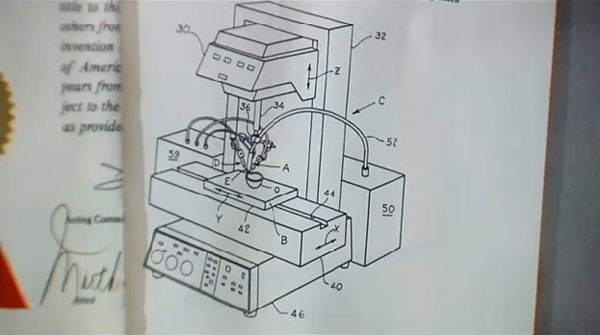
Hull and Deckard’s inventions have become central to additive manufacturing. But Bill Masters of Greenville, South Carolina also claims the title of Father of 3D Printing. His claim rests on holding the first patents granted for a 3D printer.
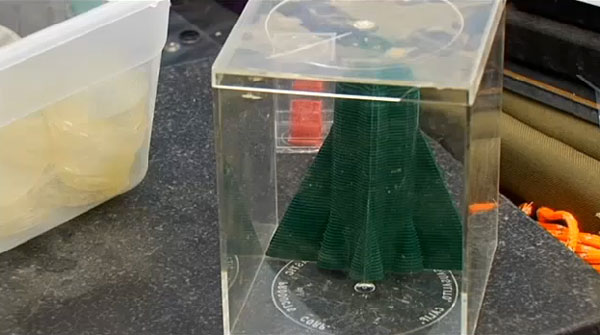
 Masters, an inventor, said his initial conception for what would one day become 3D printing was a pretty simple, but ultimately revolutionary, construct.
“I came up with the spit ball analogy,” Master says. “You stand on a balcony and you throw a spit ball down and it sticks. You throw another one, and another one and another one. It starts sticking, sticking, sticking and starts to grow sides on it making a cup out of spit balls. It could have been clay – but spit balls sounded cooler.”
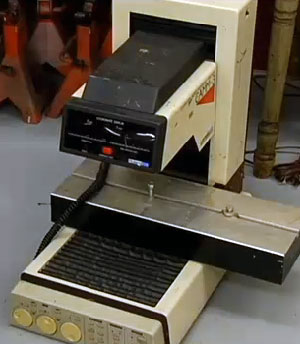
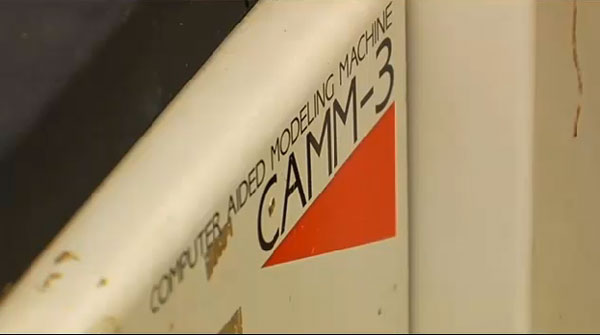
His idea was a hard sell in the late seventies and early eighties when he first proposed the technology, so he created his first 3D printer, the CAMM3 (Computer Aided Modeling Machine), to demonstrate the concept.
“I thought if you had a place to stop (material) that would be a seed point,” Masters said. “Then you could start shooting out something and let it crash into that and put another one and another and another one.”
Now Masters holds several patents for 3D printing processes.
“Out of the six known ways of doing 3D printing,” Masters says. “I have landmarked patents on three.”
References
- U.S. Patent 4,575,330 (google.com)
- Dr. Carl Deckard (me.utexas.edu)
- Bill Masters of Greenville, South Carolina (greenvilleonline.com)